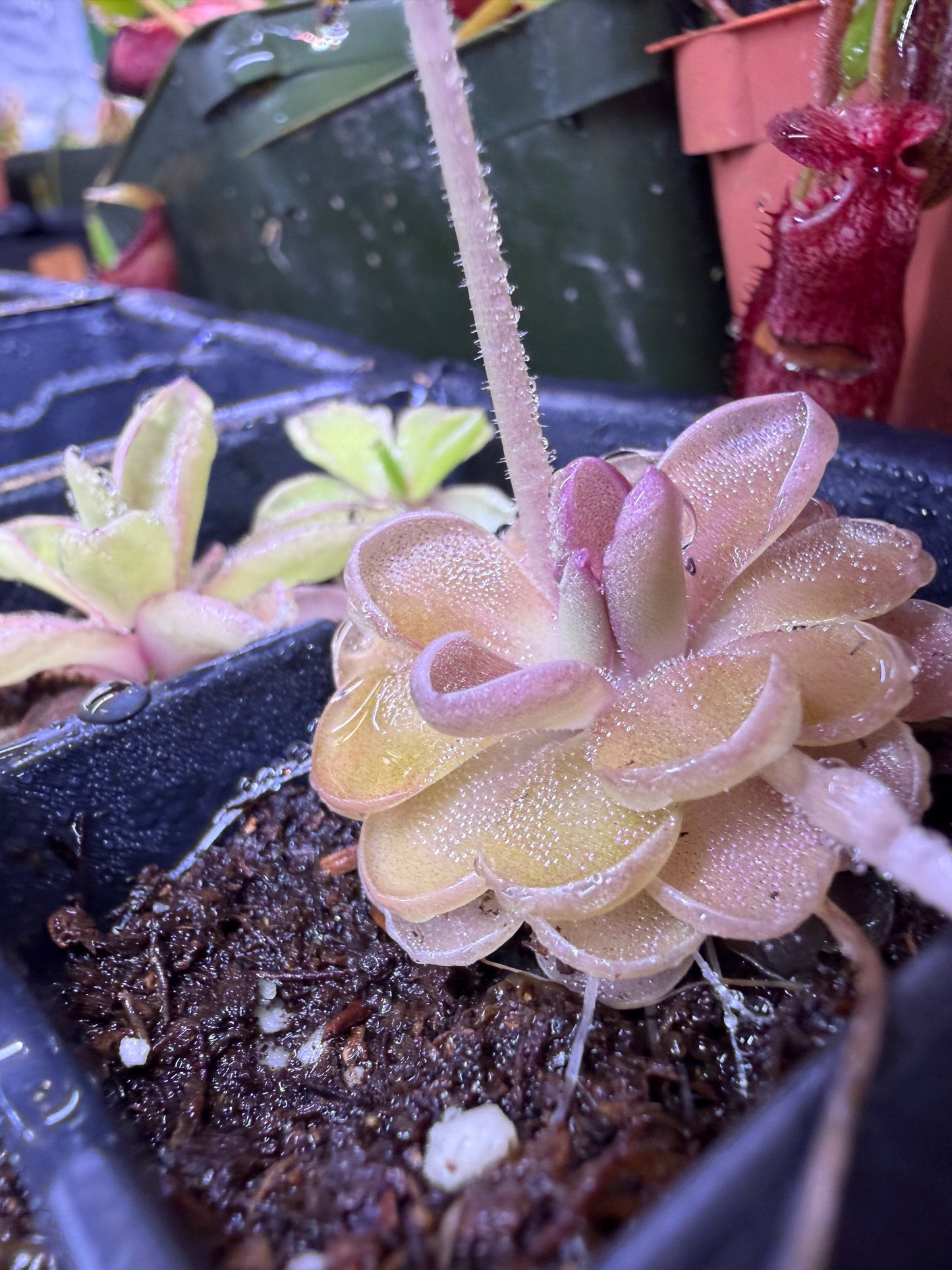
Pinguicula "Leilani" - Mexican Butterwort (Shipped Bare-Root)
Pinguicula "Leilani" - Mexican Butterwort (Shipped Bare-Root)
Couldn't load pickup availability
Pinguicula "Leilani"
Pinguicula laueana x P. cyclosecta
"Leilani" is a striking Mexican butterwort hybrid, bred in house by Rainbow Carnivorous Plants and named in honor of a beloved family member.
The leaves are a delicate lavender to soft purple, deepening into darker purple rims under strong light. It grows slightly larger than P. cyclosecta while holding onto that parent's rich coloration, forming a compact, glossy rosette that looks almost painted. Under bright conditions the whole plant intensifies into a deep, saturated purple that few other pings can match.
The flowers are the real showstopper: vivid purple to magenta blooms, sometimes described as an almost ultraviolet purple pink, held above the foliage on slender stems.
Every leaf is coated in glandular hairs that trap fungus gnats, fruit flies, and other small insects on contact. As an intermediate tropical hybrid, "Leilani" appreciates a bit more warmth and humidity than standard Mexican butterworts, but it is still far easier than most carnivorous plants and does not require a full terrarium setup.
A gorgeous, slightly less common pick for collectors looking to branch out from the usual Mexican ping lineup.
-----
## Care at a Glance
**Light** — Bright indirect to direct; intense light drives deep pink coloration
**Water** — Distilled, rainwater, or RO only; tray method during active growth
**Soil** — Well draining, low nutrient mix; perlite heavy or purpose made Pinguicula blend
**Temperature** — 60 to 85°F; no frost tolerance
**Dormancy** — May shift to smaller succulent leaves in winter; reduce watering during this period
**Humidity** — Adaptable; no terrarium required
-----
## Shipping
Your plant arrives bare root, carefully packed for safe transit. Pot it up upon arrival in a well draining, low nutrient mix. A perlite heavy or purpose made Pinguicula blend works perfectly.
If your order arrives in winter, the plant may be in its succulent dormancy phase with smaller, tighter leaves. This is normal. Do not overwater during this period.