


How to Grow Venus Flytraps - Dionaea

Official Guinness World Records™ title holder for the largest Dionaea muscipula ever grown. That record-breaking passion for flytraps drives everything we stock and ship. Learn more about us →
What Are Venus Flytraps?
Venus flytraps (Dionaea muscipula) are temperate carnivorous plants native to the coastal bogs of North and South Carolina. They are the only species in their genus, and one of the most recognizable plants on earth — capable of snapping their lobed traps shut in under a second when triggered by an unsuspecting insect.
They are far tougher than their reputation suggests. The mistake most growers make is treating them like a tender houseplant. Give them what their natural habitat actually provides — brutal sun, pure water, lean soil, and a cold winter — and they grow fast, multiply freely, and produce traps season after season.
The single best thing you can do: Grow them outdoors in full sun whenever possible. This solves the majority of common problems instantly — light, temperature swing, and natural feeding all taken care of at once.
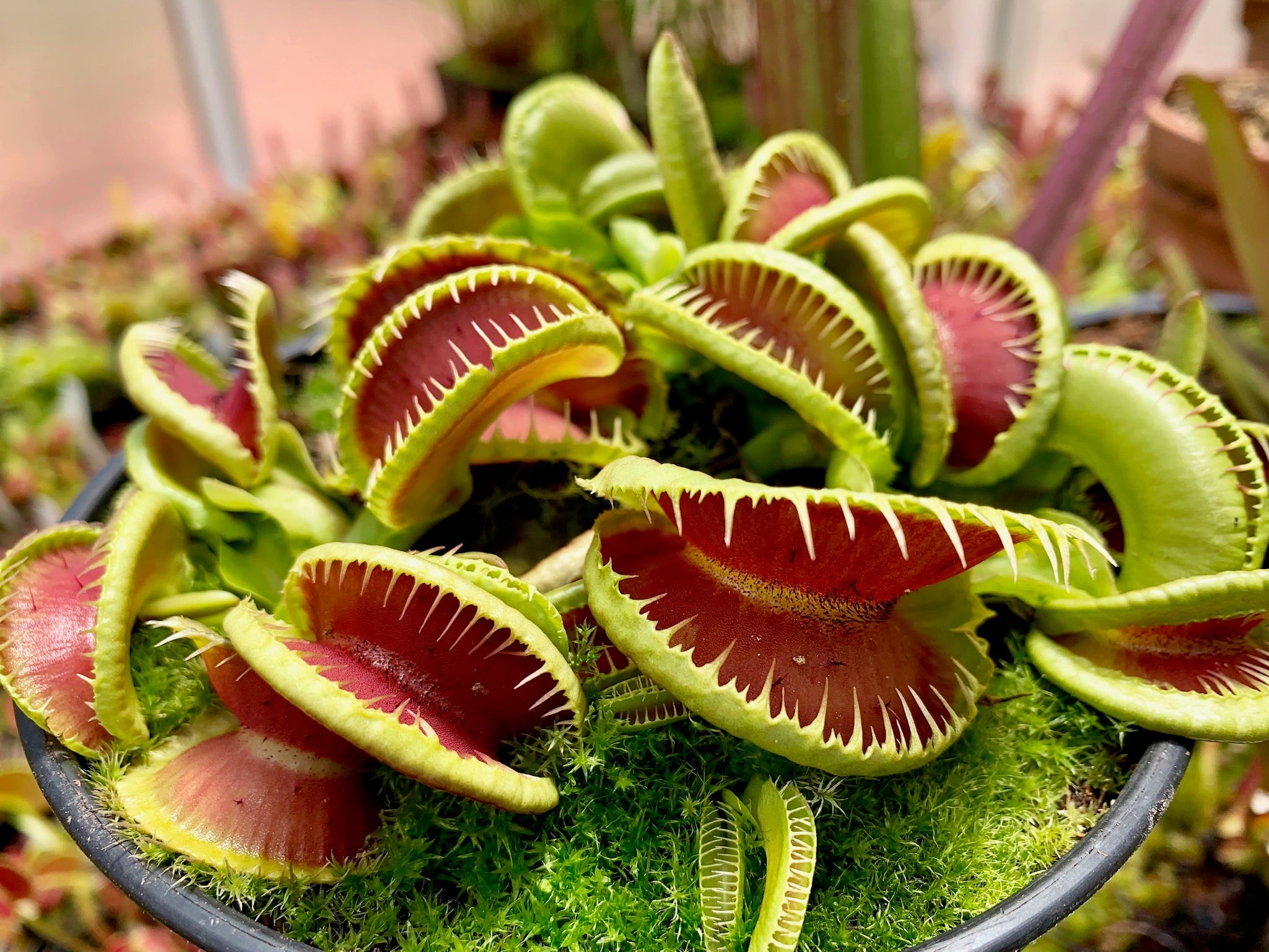 Grown in our Colorado greenhouse — hundreds of cultivars in stock
Light Requirements
Venus flytraps need full, direct sun for 6–8+ hours per day. This is non-negotiable. Insufficient light is the single most common reason flytraps fail indoors. A sunny windowsill is rarely enough — a south-facing window with no obstruction is the minimum, and even then, most plants do better with supplemental lighting.
Best Light Sources
- Outdoors in full sun (always the best option)
- South-facing window with direct sun for 6+ hours
- LED or T5 grow lights, 6–12 inches above the plant
- Greenhouse bench position with no overhead shading
Reading Your Plant
- Weak, floppy, elongated traps → not enough light
- Deep red interior on traps → ideal conditions
- Short, compact growth with vivid color → perfect
- All-green traps with no red → increase light immediately

Winter Dormancy — Don't Skip This
Venus flytraps are temperate plants with a hard-wired seasonal cycle. They require a cold dormancy period every year to remain healthy long-term. Skipping it doesn’t kill the plant immediately — but it weakens it slowly, year by year, until it declines and dies. This is one of the most common reasons flytraps fail after the first season.
Active Growth
Full sun, warm temperatures (70–90°F), tray method watering. Fastest trap production of the year.
Transition
Growth slows slightly. Begin reducing watering frequency. Plants prepare for the cold ahead.
Dormancy
32–50°F for 1–3 months. Traps shrink and die back. Keep soil damp, not soaked. Light frost is fine.
Emergence
New rosettes emerge as temperatures rise. Increase watering and move back to full sun. Growth accelerates fast.
Dormancy Methods
- Outdoor dormancy (best) — leave the plant outside through fall and winter; shelter from hard freezes below 20°F
- Fridge dormancy — for warm climates where outdoor temps don’t drop enough; store in the vegetable drawer in barely damp sphagnum for 2–3 months
- Unheated garage — works well in cold-climate areas; keep temps between 32–50°F
No dormancy = slow decline. A plant kept warm year-round may look fine for one or two seasons but will weaken and die without the cold reset. If you’re growing indoors in a warm climate, fridge dormancy is simple and effective.
Watering Venus Flytraps

Use only distilled water, rainwater, or reverse osmosis water. Tap water, even filtered tap water, contains dissolved minerals that accumulate in the soil and damage roots over time. This is the #2 cause of flytrap death after insufficient light.
The Tray Method
- Keep ½–1 inch of pure water in the saucer at all times during the growing season
- Refill before it runs dry completely
- Top water occasionally to flush any mineral buildup
Dormancy Watering
- Reduce during winter — keep soil damp, not waterlogged
- No standing water in the tray during dormancy
- Resume tray method when new growth appears in spring
Never let them dry out. Unlike most houseplants, flytraps tolerate sitting in water during active growth. Drying out is far more dangerous than being too wet in summer.
Growing Media
Venus flytraps evolved in nutrient-poor, acidic bog soil. Any fertilizer, compost, or nutrient-enriched soil will burn their roots and kill them. Keep it lean.
Recommended Mixes
- 1:1 peat moss + perlite — the classic, reliable mix
- Long-fiber sphagnum + perlite — excellent alternative with good drainage
- Optional: add silica sand (not play sand) for extra drainage in wetter setups
Never use: Regular potting soil, Miracle-Gro, compost, or any mix with added fertilizer. Even "natural" amendments like bark compost will cause root damage. If you can’t confirm a mix is fertilizer-free, don’t use it.
Repot every 1–2 years, ideally in late winter or early spring just as dormancy ends. Flytraps divide naturally over time — each division can be potted up separately for free new plants.
Feeding Your Flytraps
Outdoors, flytraps catch their own food and need no supplemental feeding at all. Indoors or in enclosed growing environments, occasional feeding accelerates growth noticeably.
What to Feed
- Live or freeze-dried insects — small crickets, fruit flies, mealworms
- Fish food flakes — small pinch, easy and effective
- MaxSea fertilizer at ¼ strength — applied directly into traps once a month, or as a very dilute foliar spray
How to Feed
- Only feed traps that are fully open, healthy, and can close completely
- Use a piece of food no larger than 1/3 the size of the trap
- Gently stimulate the trigger hairs after placing food to initiate the digestion response
- Never feed a trap in dormancy, or one that is browning or damaged
- Don’t trigger traps with non-food objects — repeated empty triggers weaken the trap
Don’t overfeed. One or two traps at a time is plenty. A well-lit plant in full sun doesn’t need feeding to thrive — it’s a bonus, not a requirement.
Best Cultivars for Beginners
We carry hundreds of cultivars — from classic beginner forms to rare collector specimens and record-breaking giants. These are strong starting points if you’re new to flytraps:

UK Sawtooth
A classic sawtooth-type with dramatically serrated trap edges that give it a ferocious look. Vigorous grower, excellent color in full sun, and one of the most visually distinctive cultivars for beginners to start with.
Browse flytraps →
Green Dragon
A clean all-green form with large, symmetrical traps and a strong growth habit. Straightforward to grow and a great contrast piece alongside red cultivars — the vivid green stays bold even in high-light conditions.
Browse flytraps →
GJ Goliath
One of the premier large-trap cultivars available. GJ Goliath produces exceptionally wide, powerful traps that are as impressive in action as they look. Fast-growing and rewarding — a standout addition to any collection.
Shop giant flytraps →
Great White Shark
Named for its elongated, tooth-like trap cilia and aggressive snapping action. A robust cultivar with strong, upright petioles and great trap production. Handles beginner care well while looking anything but basic.
Browse flytraps →
FTS Crimson Sawtooth
Deep red traps with the jagged sawtooth edge that collectors love, all in one package. Developed by Fly Trap Store, this cultivar turns an intense crimson in full sun and grows vigorously. One of the best value-to-impact cultivars we carry.
Browse flytraps →
A2 Clone
A well-established, proven cultivar with large traps and reliable performance season after season. The A2 Clone has earned its reputation among growers for consistent size and strong trap response — a solid choice for anyone building a serious collection.
Browse flytraps →Common Problems & Fixes
Black Traps
Most of the time, completely normal. Individual traps have a lifespan of 3–5 trigger events before they die back naturally. A plant losing old traps while producing new ones is healthy. If the entire plant is going black, check for root rot, bad water, or a temperature extreme.
No Trap Production / Weak Traps
Almost always a light problem. Flytraps need genuine full sun — not bright indirect, not a north window. Move the plant to direct sun outdoors or upgrade to a high-output grow light. Results are usually visible within one leaf cycle.
Slow Decline After the First Year
The #1 cause is missing dormancy. A flytrap that never gets a cold period will weaken progressively. If your plant survived its first season but is producing smaller, fewer, or paler traps the following year, this is almost certainly the reason.
Sudden Death / Root Rot
Usually caused by tap water or fertilized soil. If caught early, remove the plant, trim rotted roots back to white healthy tissue, repot in fresh pure media, and reduce watering until new growth appears. Prevention is much easier than recovery.
Traps Won’t Close Properly
Traps that have been triggered repeatedly without food lose their responsiveness and eventually die back. This is normal and not a health problem — new traps will replace them. Avoid allowing children or visitors to trigger the traps repeatedly for fun.
Quick reality check: If your flytrap isn’t thriving, it’s almost always one of three things — (1) not enough sun, (2) wrong water, or (3) no dormancy. Fix those and everything else usually resolves on its own.
 Over 400 cultivars available — all grown here in Colorado
Ready to Grow Venus Flytraps?
Browse hundreds of cultivars from beginner classics to record-breaking giants. All vegetatively propagated in our Colorado greenhouse and shipped bare-root across the USA.