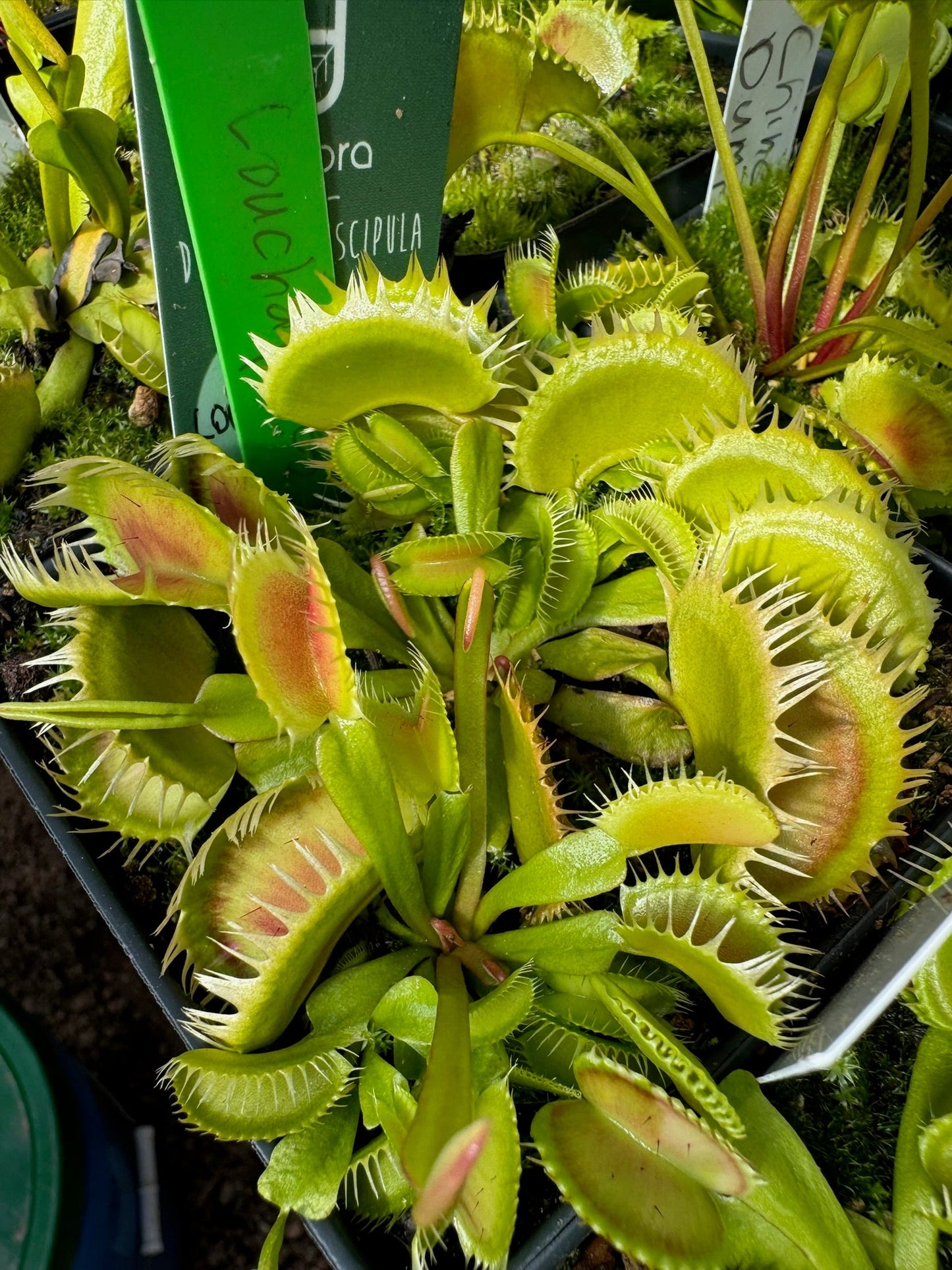
Dionaea muscipula Louchapates (Shipped Bare-Root)
Dionaea muscipula Louchapates (Shipped Bare-Root)
Couldn't load pickup availability
Originated by Romuald Anfraix of Lyon, France in 2000 from a batch of Fused Tooth plants and registered in 2004, Louchapates is named after the culinary tool used to serve spaghetti noodles — an apt description of its flattened, forked teeth. Unlike the typical Fused Tooth clone where teeth are broadly webbed together, each tooth in Louchapates is individually flattened in cross-section, about 2 mm wide, with tips that are often multiply divided revealing the fusion. Marginal teeth also appear at the apex of the trap lobes, a feature shared only with Cupped Trap among registered cultivars. This is not a member of the Dentate Traps Group since the teeth originate from fused spines rather than being triangular by nature.
Care Requirements
Light — 6+ hours of direct sun daily. A south-facing window or outdoor placement in full sun is ideal.
Water — Pure water only, under 50ppm dissolved solids. Use distilled, reverse osmosis, or collected rainwater. Most tap water will not work. Keep roots sitting in a shallow tray of water.
Soil — Pure peat moss or long-fiber sphagnum, with optional perlite or sand added for drainage. Garden soil will not work.
Dormancy — Required. Allow 3 to 4 months of cold dormancy each winter for long-term health.
Hardiness — Zones 7–10 outdoors, or overwinter indoors in a cool location.
Shipping & What to Expect
Our bare root Dionaea muscipula (Venus flytraps) are shipped according to their natural growing cycle. During the active growing season (spring through early fall), you'll receive a plant with live traps, often in vibrant color. In the winter months, Venus flytraps naturally enter dormancy and will be shipped without leaves or with small winter rosettes — this is completely normal and essential for the plant's long-term health.
Please note that the plant and photo shown are representative of the variety but not the exact plant, size, or stage of growth you will receive. You will receive one plant; photos may occasionally show multiple plants for reference. Each plant is unique, and we guarantee a healthy, established plant ready to grow.